
Trump’s shock tariff announcement has sent the financial markets into a tailspin.
Although he gave advance warning that he would be imposing reciprocal tariffs, these were, in many instances, far higher than expected and cannot be classified as reciprocal. In addition to 34% tariffs on China, 26% on India, 20% on the European Union, and 10% on the United Kingdom, Vietnam was slapped with 46% tariffs and Thailand 37%. Even islands inhabited only by penguins and other wildlife are subject to 10% tariffs.
Economies do not function well in uncertain environments, and it has been nearly impossible to determine Trump’s endgame with tariffs.
He claims it is to Make America Great Again, but it is becoming increasingly clear that he is using tariffs more as a political tool than as an economic policy instrument. This makes it challenging to understand whether he will adhere to his decisions or alter them, as he did when he announced significant 25% tariffs on Canada and Mexico, only to pause their implementation to allow leaders of the two neighbouring countries to make concessions. Yet, he ultimately proceeded regardless.
Thus, we know that Trump can change his thinking on a dime. He has already said that many countries are lining up to negotiate with him, and he is willing to consider tariff reductions if they offer “something phenomenal.” Any decision to reduce tariffs could positively impact markets in the short term. However, longer-term concerns about the business and investment environment would prevail.
After Trump’s announcement, markets responded with significant sell-offs across equity and commodity sectors. Oil prices plummeted to around $60 per barrel. Meanwhile, Wall Street’s fear gauge, the Volatility Index (VIX), surged to its fourth-highest level ever. The broad decline in stock markets underscores the profound anxiety among investors, stemming not from revised growth expectations or adjusted company earnings forecasts, but from the sudden “shock and awe” of the announcement itself.
Trump appears unperturbed by the waves of red in stock markets. More focused on Main Street rather than Wall Street. However, both are intertwined, and their impact will trickle down into the broader economy.
Thus, to understand tariff uncertainty’s real-world impact, we must pay particular attention to business sentiment.
Not knowing what Trump might do next means companies will likely become more hesitant about making long-term decisions, including whether or not to make further investments in their manufacturing capacity, increase their headcount at work, or raise inventory levels. They may well build up their cash reserves instead.
In addition, consumers, who are the primary drivers of economic growth, may begin saving more than spending to create a buffer that will help them navigate uncertain times. None of these behaviours are favourable for economic growth.
It’s also worth noting that President Trump’s popularity on Main Street is falling.
Surveys show that his approval rating has fallen to 43% just 76 days into his term—substantially lower than the typical 55% approval rating that previous presidents, including Republicans, enjoyed in their first 100 days.
The Federal Reserve’s response remains another significant unknown. If tariffs trigger significant inflationary pressure, it is unclear how the Fed will balance its mandate to control inflation against the need to support economic growth. Fed Chairman Powell has already begun making cautionary statements, while even some of Trump’s political allies have started voicing politically correct concerns about his tariff decisions.
Markets function on anxiety, making investing during turbulent times especially challenging.
At Levantine & Co, we believe that the most prudent strategy during market volatility is to maintain well-diversified portfolios that align with client needs and risk tolerances. For those invested in balanced portfolios, the current environment underscores the importance of diversification, as fixed-income assets and alternative investments like gold offer a counterbalance to equity declines. The US 10-year Treasury yield has fallen from about 4.3% to 3.9%, increasing bond values as equities decline.
For growth-oriented investors, this volatility can provide an opportunity to lower the average cost basis of their portfolios.
The path forward
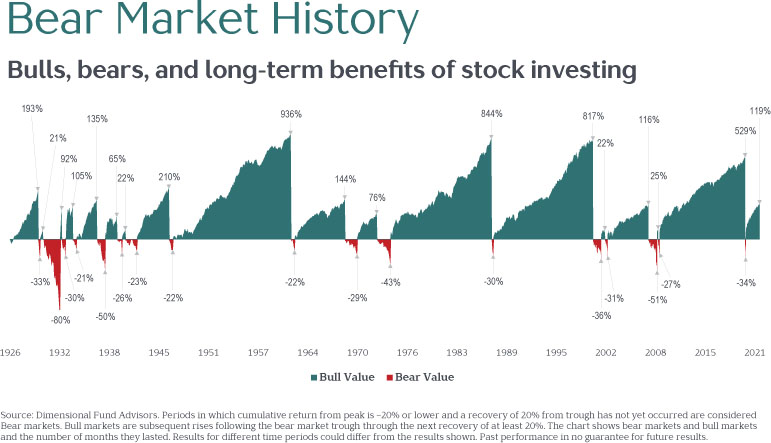
History shows that markets have consistently recovered from periods of uncertainty and volatility over the past 26 years.
The graph below shows the extent to which bull markets typically outweigh bear markets in terms of magnitude and length of time.
Source: Vista
It’s too early to predict how the current situation will resolve, as several scenarios could unfold.
Thus, the most important advice for investors remains: stay the course and avoid making reactive portfolio adjustments based on current headlines. Making hasty changes during times of high volatility often results in locking in losses and missing the eventual recovery.
Well-positioned portfolios include broader geographic diversification and exposure to markets that are currently outperforming developed markets. Fixed income and alternative assets, such as gold, that we hold in our portfolios can provide additional stability during turbulence in equity markets.
While uncertainty is likely to persist, given Trump’s track record of politically motivated tariff decision-making, a disciplined investment approach and diversification are crucial in navigating the shift to an unknown new world economic order.
If you’d like to talk to us about this, please setup an online meeting or contact us directly.